
What is Manual Lymphatic Drainage (MLD) and How Can It Help You?
Manual lymphatic drainage was researched and developed in the 1930s by Emil Vodder, a Danish physiotherapist. Numerous research studies have verified the efficacy of the technique since that time. Manual lymphatic drainage encourages lymph flow and reduces certain types of edema.
How the Lymphatic System Works
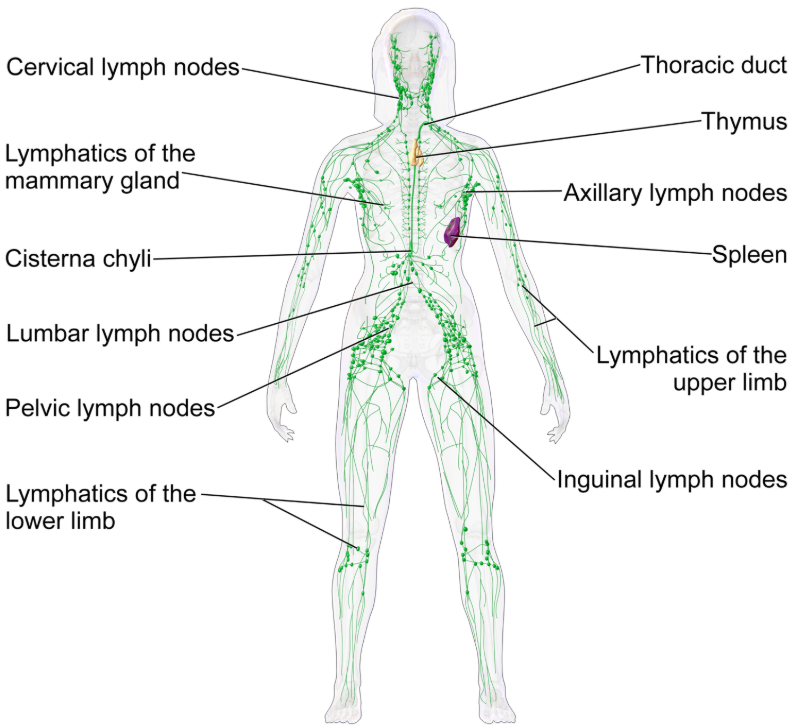
The lymphatic system is largely a passive one. It relies primarily on surrounding skeletal muscles and the action of the diaphragm to move lymphatic fluid through its capillaries, nodes and ducts. The larger abdominal and thoracic ducts have contractile abilities and recent studies may indicate that the superficial lymphatic capillaries also have a minor capability to contract.
The MLD Technique
During a treatment, light, repetitive techniques are used to pump the lymphatic fluid through the superficial lymphatic capillaries. Here is what you can expect during a session:
- During the technique, the therapist’s hands are soft and relaxed.
- No lubricant is needed, although talcum powder may be used to facilitate drag.
- Each manipulation must be repeated a minimum of five to seven times in order to pump the lymphatic fluid through the tissue.
- The strokes are unidirectional and overlapping.
- The pressure is applied centripetally, or towards the heart, in a rhythmic manner, starting at the proximal lymph nodes and working distally towards the edematous site.
- Thorough treatment of a single limb may take up to 20 minutes.
- A pressure of 20 to 40 mm Hg is used to avoid collapsing the superficial lymphatic capillaries.
- An average pressure of 30 mm Hg has been found to have the greatest effect on moving the lymph.
Key Benefits
- The slow, repetitive, rhythmical nature of these techniques decreases pain perception and the effects of the sympathetic nervous system.
- With edema resulting from acute or subacute trauma, manual lymphatic drainage techniques are useful in reducing the formation of scar tissue.
- This reduction of scar tissue is accomplished by the removal of fibrin from the initial lymphatics.
- Edema resulting from connective tissue restrictions such as post-surgical scarring can also be treated.
- The techniques improve the clearance of substances like histamine, corticosteroids, and noradrenaline from edematous tissues, which suggests they remove other metabolic wastes.
Contraindications
While highly effective, MLD is not for everyone. Contraindications to lymphatic drainage techniques include chronic heart failure, acute conditions due to bacterial or viral infection, recent thrombosis, low-protein edemas due to kidney pathologies, malignancy and lymphatic obstruction by parasites.