
Unlocking the Techniques of Swedish Massage: What Happens on the Table?
When you book a massage at WoVe Massage Therapy here in Bradford, you are trusting me to help you find relief from pain, stress or tension. To achieve those physiological and psychological effects, Swedish massage techniques make up the classical manipulations used by a massage therapist.
While you are relaxing on the table, I am consciously applying these specific soft tissue techniques to assess and treat your muscles. If you have ever wondered exactly what your therapist is doing during a session, here is a breakdown of the classical Swedish techniques.
The Building Blocks of a Great Massage
Before we look at the specific strokes, it helps to understand how a massage therapist modifies their touch to achieve different results. Swedish techniques can be categorized by several components:
- Direction of movement: For relaxation or the reduction of edema, the direction is centripetal (towards the heart). For the treatment of fibrotic areas, techniques are applied in a cross-fibre direction.
- Pressure: For relaxation, the pressure applied is usually light to moderate. Deeper pressure is used to reach deeper structures and for the treatment of adhesions.
- Rate of movement: For relaxation, the rate of movement is slower. For a stimulating effect, techniques are applied more quickly.
The 5 Core Swedish Techniques
These are the foundational movements you will feel during your treatment:
- Stroking: This is among the lightest techniques used for massage. It is often used as an introductory or closing technique. Repetitive stroking is considered to be a soothing technique that decreases sympathetic nervous system firing.
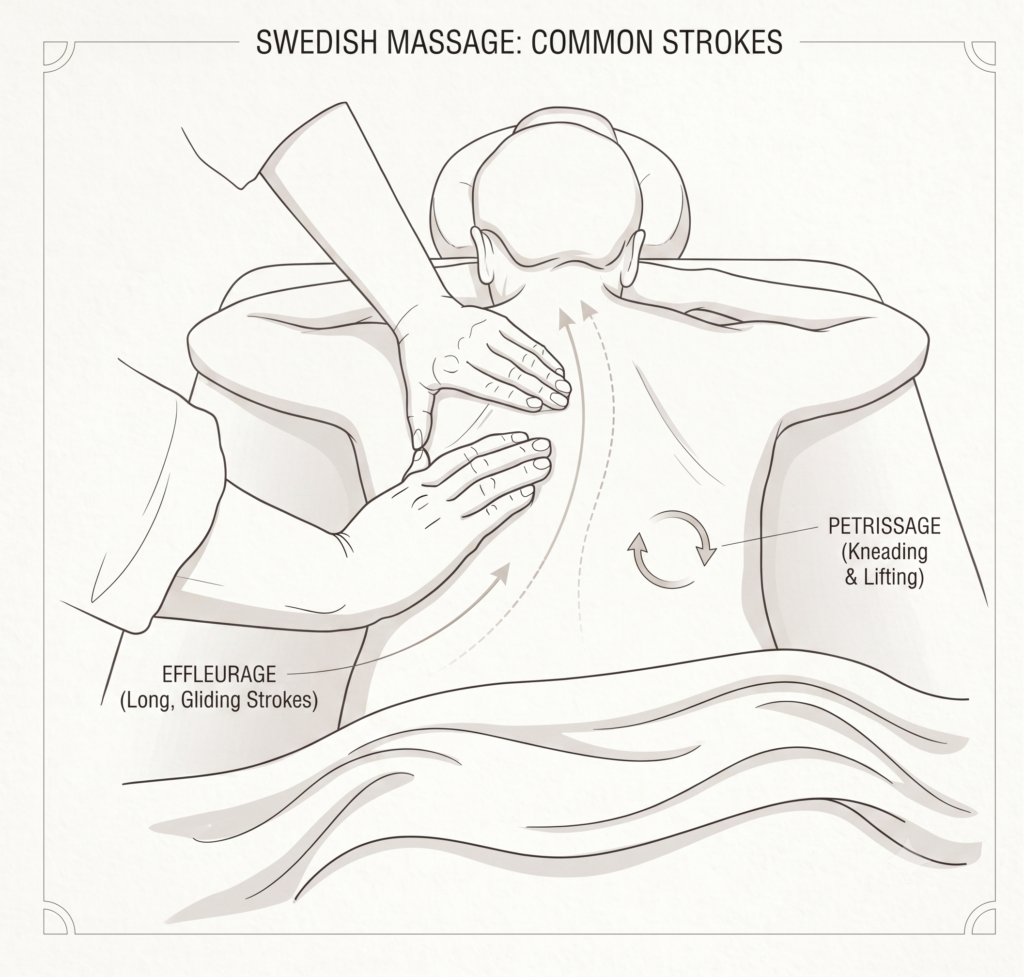
- Effleurage: This term comes from the French word meaning to glide, stroke or touch lightly. It is used early in a massage to spread the lubricant. Slow rhythmic effleurage has a sedative effect, while quick and erratic effleurage is stimulating.
- Petrissage: Originating from the French word meaning to knead, this technique rhythmically compresses and releases the tissue. It includes techniques like muscle squeezing, muscle stripping, wringing, picking up and skin rolling. All types of petrissage affect local circulation and reduce muscle hypertonicity.
- Vibrations: These are oscillations to the tissue. They can be fine or coarse. Fine vibrations are more soothing than coarse vibrations.
- Tapotement: This comes from the French word meaning to rap, drum or pat. It includes tapping, hacking, cupping and beating. The primary purpose of tapotement is to loosen mucus in clients with respiratory conditions, but it also increases local circulation.
A Note on Lubricants
To perform these techniques effectively, a therapist uses a lubricant to reduce drag and to facilitate gliding over the skin.
While there are many oils and lotions available, jojoba oil may also be used as a lubricant. This is actually a plant wax that is liquid at room temperature. Because it is a wax, jojoba has the advantage of not oxidizing, and it is light and odourless. This is why I have proudly switched to using 100% pure and organic Jojoba oil in the clinic!
Whether you need deep petrissage to relieve commuting stiffness or soothing effleurage to unwind, these classic techniques are the foundation of your care.